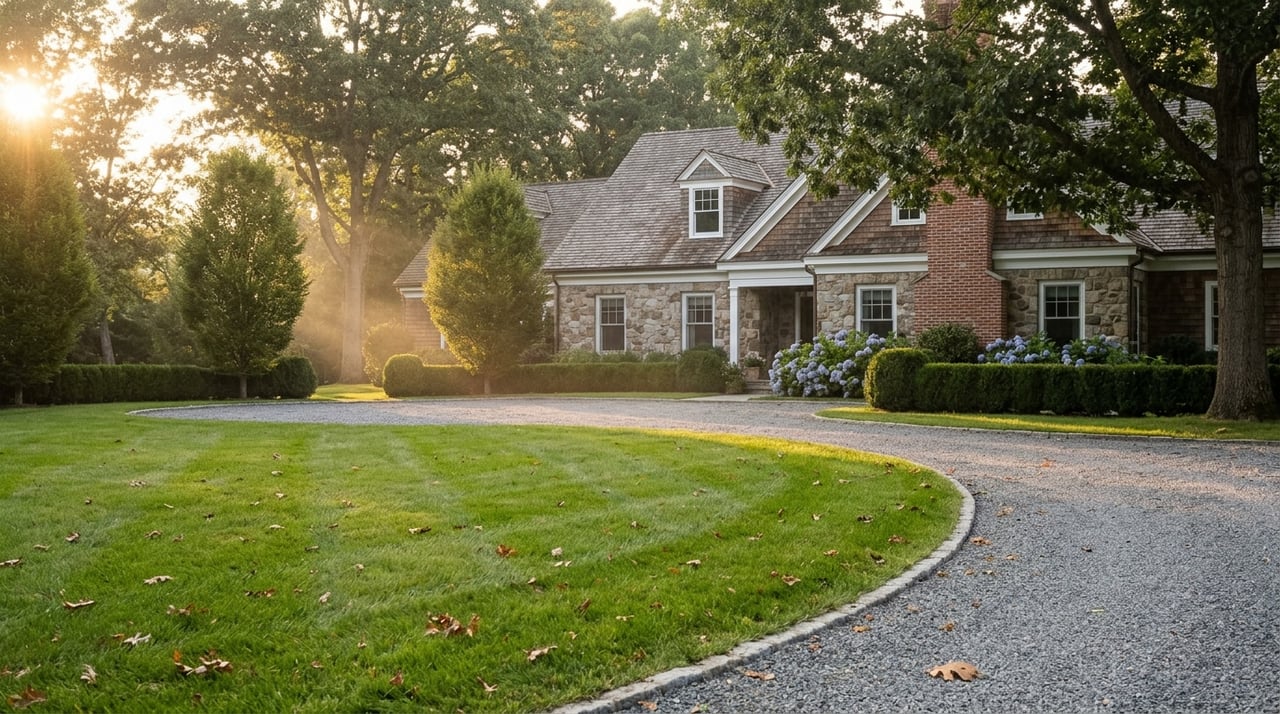
Two houses go on the market within a few weeks of each other. Same price band, same school assignment, roughly the same lot size, ten minutes apart by car. On paper they read like the same decision. Then a buyer actually tests the weekday commute and finds that one address puts her on a train that runs straight through to Grand Central, while the other puts her on a train marked with a small letter "C" on the timetable, meaning she has to get off at Stamford, cross the platform, and wait for a second train to finish the trip.
That letter is the whole story. It is not on the listing sheet, not in the square footage, and not in the town's median price. But it can add real minutes to every single workday for as long as she owns the house.
Why New Canaan Even Has This Problem
New Canaan does not sit on the Metro-North New Haven mainline the way Darien, Westport, and Norwalk do. It sits at the end of a spur. The New Canaan Branch runs 8.2 miles from a junction east of downtown Stamford up to the New Canaan station, and it has carried passengers since 1868. On weekdays, many branch trains continue straight through to New York without requiring anyone to change trains. Others end their run at Stamford, where the branch meets the mainline, and passengers have to transfer to keep going.
That distinction does not exist for a Darien or Westport buyer standing on a mainline platform. It exists for every New Canaan commuter, on every train, every day, and it is baked into the geography of the town rather than into any one property.
The Letter That Isn't on the Listing Sheet
Metro-North marks the trains that require a change with a "C" on its own printed key: "Change trains to continue your trip." Under the timetable that took effect March 29, 2026, the fastest weekday option from New Canaan is the 5:30 a.m. departure, which runs direct into Grand Central at 6:43 a.m., a 73-minute trip. Later in the morning, several trips carry that same "C," and the same origin-to-destination distance can stretch closer to 80 minutes once the Stamford transfer is factored in. Local guidance for buyers relocating from New York generally puts the range at 60 to 80 minutes from the New Canaan station and 60 to 75 minutes from Talmadge Hill, with the gap between a direct trip and a transfer trip commonly running 10 to 30 minutes depending on the hour.
The dollar side of that friction is just as concrete. New Canaan sits in Zone 31, where a monthly pass currently lists at $334.75, a weekly pass at $119.00, and a one-way fare between $12.50 off-peak and $17.00 peak. Peak pricing applies to any train arriving at Grand Central between 6 and 10 a.m., and to departures from Grand Central between 6 and 9 a.m. and again between 4 and 8 p.m., which covers almost every trip a full-time office commuter would actually take.
None of that shows up in a listing's bullet points. All of it shows up in year one.
How the Geography Sorts the Trains
New Canaan's informal neighborhoods track this rail structure more closely than most buyers expect.
The village core, centered on Elm and Main Streets, is built for walking to the station. The town maintains more than 20 miles of local sidewalks along with pedestrian crossings and seasonal in-street stanchions downtown, and homes here trade car dependence for proximity to whichever train happens to be running that hour.
Talmadge Hill, one stop south on the same branch, is the compromise position. Buyers here accept a smaller lot in exchange for still being a short walk or drive to a station on the branch itself, with the same direct-versus-transfer math applying to whichever platform they use.
The West Side is a different trade entirely. The New Canaan Land Trust describes this part of town as home to the reservoirs, the Glass House, Country School land, and several protected open-space tracts, and it is genuinely more car-dependent: getting to either station means driving first. Ponus Ridge, one of the more recognized West Side pockets, currently spans roughly $2 million to $7 million and up for larger parcels with more privacy and acreage.
East of Smith Ridge Road and north of Route 106, an area locally referred to as the Upper East Side, offers more separation from downtown and a quieter, more wooded feel. It has been pitched by agents in the past as relative value against the in-town premium, though that positioning is worth testing against actual recent closings in that specific pocket rather than assumed from an old reputation.
| Submarket | Relationship to the rail | Everyday character | Where pricing sits (2025 to 2026) |
|---|---|---|---|
| Village core (Elm/Main St) | Short walk to New Canaan station | Sidewalks, downtown errands on foot, first crack at direct trains | Downtown condos from roughly $500K; in-town single-family climbing fast off that base |
| Talmadge Hill | On the branch, one stop south | Updated colonials and newer infill, smaller lots for rail proximity | Comparable to the broader entry tier, roughly $1.7M and up |
| West Side (Ponus Ridge area) | Drive to either station | Reservoirs, the Glass House, Land Trust acreage, more privacy | Roughly $2M to $7M+ for larger parcels |
| East Side / "Upper East Side" | Drive to either station, farther from both | More separation from downtown, quieter roads | Historically marketed as relative value; confirm against current comps in the specific pocket |
The point of the table is not that one submarket is better. It is that "New Canaan" is not one product, and the rail relationship is one of the clearest, least advertised reasons why.
Why the Headline Median Won't Settle This For You
Even if a buyer ignores the rail question entirely, the town-wide median price is a poor tool for comparing New Canaan to anywhere else right now, because New Canaan simply does not close enough homes in a given month to produce a stable number.
In March 2026, one widely used index put New Canaan's median sale price at $1.4 million, down 17.1 percent year over year. That figure was built on three closed sales, down from five in the same month a year earlier. A different tracking service, using its own methodology, put the town's median home value at just over $2 million as of May 2026, up 8.7 percent over the prior twelve months. A third source listed New Canaan's median list price in July 2026 at $2.59 million, at $618 per square foot, with homes spending a median of 28 days on the market, three percent faster than the year before.
Three sources, three different numbers, all describing the same town in the same rough window. The gap is not a sign that someone is wrong. It is a sign that when only a handful of homes close in a given month, whichever few happen to close, luxury estate or in-town starter, swings the "median" more than any real shift in the market underneath it. A fuller-year read is steadier: 2025 closings put the average single-family sale price around $3 million, up from roughly $2.5 million in 2024, against about two months of supply and homes actually spending something closer to 39 days on the market once the standard closing runway is backed out.
If a researcher is comparing New Canaan to Darien or Westport on the strength of a single month's median, that comparison is standing on a very small number of transactions. The submarket and the rail line tell a more reliable story than the headline number does.
What to Actually Test Before You Write an Offer
- Pull the specific weekday train nearest your real commute window on the New Canaan Branch timetable and check whether it carries a "C." A direct train and a Stamford transfer at the same departure time are not the same commitment.
- Walk or drive the exact station-to-door route at the hour you would actually leave, not at an open house's midday showing time.
- Price the Zone 31 monthly pass into your household budget the same way you would a mortgage line item, not as an afterthought.
- Ask plainly whether the address is a walk to the village core or a drive to either station. Both are legitimate choices. They are not the same choice.
- Before anchoring on any single reported median, pull two or three months of closed sales in the specific submarket you are considering rather than the townwide figure for the month you happen to be searching in.
FAQ
Does every New Canaan train require a change at Stamford? No. Several weekday trains, including the earliest morning departure, run direct to Grand Central without a transfer. Others are specifically marked with a "C" on the timetable to indicate a required change. The mix changes by time of day, so the only way to know for a specific commute window is to check that day's schedule directly.
Is Talmadge Hill meaningfully faster than the New Canaan station? Not dramatically. Typical guidance puts New Canaan station trips at roughly 60 to 80 minutes and Talmadge Hill at roughly 60 to 75 minutes, both depending on whether the specific train requires a Stamford transfer. The bigger variable is the transfer itself, not which of the two stations you start from.
Why did the schedule change in 2026? Metro-North issued an updated timetable for the New Canaan Branch effective March 29, 2026, part of its regular schedule revisions. Anyone comparing commute times should confirm against the current timetable rather than an older printout or a secondhand estimate, since specific trip times shift with each update.
A house's price tells you what it costs. It does not tell you what your Tuesday morning will actually look like, or whether the number you are anchoring on was built on three closed sales or thirty. If you are comparing New Canaan against another Fairfield County town, or comparing one New Canaan block against another, Konstantine Wells can walk the actual comps and the actual commute with you before you write an offer. Request a free home valuation or schedule a consultation to get a submarket-level read instead of a townwide guess.